

The Passenger Transport Subsidy Scheme (PTSS) provides a subsidy for eligible people with disability, when travelling in taxis. This section provides information for PTSS participants, including managing your participation and how to catch a subsidised journey.
If you have not received your PTSS card, or have lost your card, please email ondemandtransport@transport.wa.gov.au or call 13 11 56.
The Passenger Transport Subsidy Scheme Guidelines (the Guidelines) outline the rules and obligations for:
- people who want to apply for PTSS
- people who use PTSS, and
- taxi drivers and on-demand booking services.
The Guidelines sit under the Transport (Road Passenger Services) Regulations 2020. The Guidelines must be complied with to be eligible to receive subsidies.
Easy Read - how to use your PTSS card

We have made an Easy Read book to explain how to use your PTSS card.
There are two versions of the document:
- a PDF version with pictures to explain some ideas, and
- a text-only Word version.
You can ask someone you trust for support to:
- read this document, and
- find more information.
Watch the video
Watch the quick video to find out how to use your PTSS card.
Transcript
[Text on screen: Passenger Transport Subsidy Scheme.]
[Visual: An animated clip showing a van driving in front of buildings with Perth city in the background.]
[Sound: Music playing in the background throughout.]
Narrator: The Passenger Transport Subsidy Scheme or PTSS is the digital system that replaces the Taxi User Subsidy Scheme or TUSS.
[Text on screen PTSS]
[Visual: An animated person in a wheelchair catching a purple PTSS card.]
Narrator: PTSS supports people with disability to have more transport options, by subsidising part of the cost of your taxi journey.
[Visual: A taxi van pulls up next to the person, and they show their PTSS card to the driver.]
Narrator: As a participant, you will receive a PTSS card to access your subsidy when travelling in a taxi. Your PTSS card replaces TUSS vouchers.
[Text on screen: Yellow 50% standard.]
[Visual: A yellow PTSS card.]
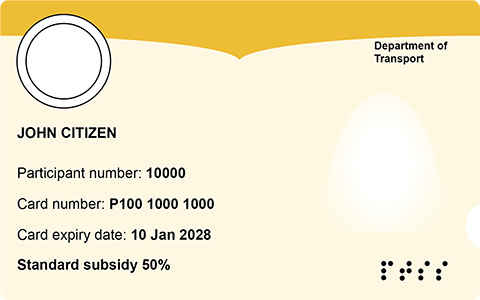
Narrator: If you get a standard 50% subsidy, your PTSS card will be yellow.
[Text on screen: Purple 50% or 75% wheelchair.]
[Visual: A purple PTSS card.]
Narrator: If you get a wheelchair subsidy of 50% or 75%, your PTSS card will be purple.
[Visual: A green Taxi User Subsidy Scheme voucher on the left and a purple PTSS card on the right.]
Narrator: If you had a green TUSS card and vouchers, you will have a purple PTSS card with the same subsidy amount you previously received.
[Visual: Purple PTSS card. The animation highlights the area of the card being mentioned.]
Narrator: Your PTSS card will include:
- your name,
- your participant number,
- a card number,
- a photo of you,
- what type of subsidy you get,
- and an expiry date.
To support people with vision accessibility needs, your PTSS card will also include:
- the letters PTSS in Braille on the front,
- and a cutout on the side.
[Visual: An animated person showing thumbs up.]
[Text on screen: By using your PTSS card, you agree to follow the conditions of use outlined in the PTSS Guidelines for Participants.
Narrator: By using your PTSS card, you agree to follow the conditions of use outlined in the PTSS Guidelines for Participants available on the Department of Transport website.
[Text on a blue screen: Government of Western Australia Department of Transport. For more information, visit transport.wa.gov.au/ptss ]
Narrator: For more information, visit transport.wa.gov.au/ptss
End of Transcript
What subsidy am I entitled to?
Standard subsidy type
The standard subsidy is for participants who don’t use a wheelchair. With a standard subsidy, you are entitled to 50% of the fare (up to a maximum of $25) when travelling in a conventional taxi.
Standard subsidy recipients will have a yellow card.
Wheelchair subsidy type
The wheelchair subsidy is for participants who have demonstrated they require a wheelchair. With a wheelchair subsidy, you are entitled to:
- 50% of the fare (up to a maximum subsidy of $25) when travelling in a conventional taxi.
- 75% of the fare (up to a maximum subsidy of $35) when travelling in a wheelchair in a wheelchair accessible taxi.
Wheelchair subsidy recipients will have a purple card.
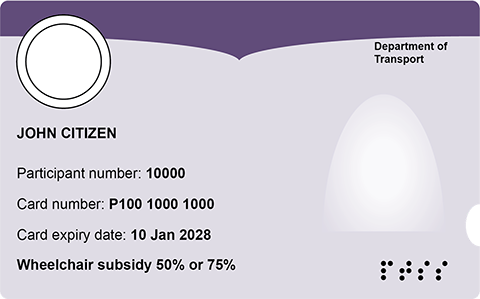
Note: If you previously had a green Taxi User Subsidy Scheme (TUSS) card, you will have a purple PTSS card with the same subsidy amount you previously received.
Your PTSS card
Your PTSS card will include:
- your name
- a card number
- a photo of you
- what type of subsidy you get, and
- an expiry date.
To support people with vision accessibility needs, your PTSS card will also include:
- the letters ‘PTSS’ in Braille on the front, and
- a cut out on the side.
The PTSS card is activated the first time it is used.
Obligations for PTSS card holders
When you use your PTSS card, you agree to follow the rules and obligations outlined in the Passenger Transport Subsidy Scheme Guidelines, including the following.
- Present a valid PTSS card at the start of the PTSS journey.
- Pay the non-subsidised portion of the fare (the total fare, minus the subsidy amount to which they are eligible).
- Always retain possession of their PTSS card.
- PTSS participants must not allow a driver to retain possession or accept delivery of their PTSS card.
- The Department of Transport and Major Infrastructure (DTMI) may suspend or cancel a participant's access to PTSS if another person is found using or in possession of the participant's PTSS card without lawful authority.
- PTSS participants must never provide information to another person or authorise another person, unless they are an authorised carer, to change their personal details, as held by DTMI.
- Do not lend, sell or transfer their PTSS card.
- Notify DTMI as soon as possible if a PTSS card is lost or stolen.
- Do not collude with a driver to obtain unauthorised PTSS payments.
- Cooperate with PTSS participant eligibility reviews and further requests for information made by DTMI.
- Do not travel in a wheelchair accessible vehicle (WAV) taxi while seated in a mobility scooter, gopher or other device that is not designed or approved for use as a passenger seat during transport.
Participant and driver relationships
PTSS participants must not use their PTSS card if they have a personal, domestic, or financial relationship with the driver. This means a PTSS participant must not use a driver, if the driver is a:
- spouse or partner
- relative
- member of the same household
- close personal associate, or
- business associate.
These examples are not exhaustive. Read the Passenger Transport Subsidy Scheme Guidelines for more information.
Lost, stolen or damaged PTSS cards
You must report lost or stolen PTSS cards to DTMI as soon as you realise your card is missing. You can contact DTMI by:
- Email: ondemandtransport@transport.wa.gov.au
- Phone: On-demand Transport on 13 11 56
Once reported, DTMI will cancel your PTSS card and send you a new one. Upon cancellation, the PTSS card will no longer be capable of accessing your subsidy. The new PTSS card will have a different card number to your previous card.
How to update your details
It is important to notify DTMI immediately of any changes to your PTSS participant details, including:
- your name
- gender
- residential and postal address
- phone number
- email address
- next of kin and carer/other contact details, and
- preferred contact.
DTMI uses this information to contact you with important information about your involvement in PTSS.
To update your details, complete the Update your Passenger Transport Subsidy Scheme contact details (ODT186) form. Submit your completed and signed form to DTMI via email or post:
- Email: ondemandtransport@transport.wa.gov.au
- Mail: On-demand Transport
GPO Box R1290
PERTH WA 6844
If you have any questions about how to update your details, please call 13 11 56 or email ondemandtransport@transport.wa.gov.au.
Changing your subsidy type
If your condition changes, you may request to change your subsidy type.
To request to change your subsidy type, we require a letter from your medical practitioner outlining:
- how your condition has changed, and
- confirming that you require use of a wheelchair.
The letter must:
- be written on the medical practitioner’s letterhead
- contain the medical practitioner’s full details, including Australian Health Practitioner Regulation Agency (AHPRA) registration number, and
- be signed by the medical practitioner.
Email this letter to ondemandtransport@transport.wa.gov.au.
This information will be assessed by an independent occupational therapist contracted to DTMI, who will provide a recommendation regarding your suitability. You will receive a letter or email from DTMI regarding the outcome of this request.
Note: You are responsible for paying any fees or charges associated with medical appointments.
Requests for information from the DTMI
PTSS participants must co-operate with and respond to any DTMI request for information about your access to or use of PTSS, including:
- an eligibility review or an independent medical eligibility assessment;
- information in relation to your access to or use of PTSS; or
- information to verify that your use of PTSS is authentic, for example when subsidy payments appear to be irregular or to exceed reasonable use.
FAQs
For more information on applying for PTSS, visit the Apply for PTSS page.
The letter you received with your new PTSS card has a barcode on it, underneath where your card was stuck to the letter. This barcode is just a part of the letter and is not used to access your subsidy.
Your new PTSS card has a chip inside it that includes your subsidy information. To use your PTSS card, just present it to your taxi driver – they will scan your card at the start and end of the journey.